
 Sileon
FinTech
Sileon
FinTech
Cloud-Based
BNPL SaaS
Case Study
Contents
2. Mission & Challenges
3. Product Design Process
4. Design System & Organization
5. Wrap Up & Handover
1. Introduction
Sileon: A New Era for Paynova
This transformation was reinforced by a strategic partnership with Visa, prompting a full-scale rebrand and internal restructuring. Leadership was renewed across Product, Tech, Marketing, and Sales, ultimately culminating in the formation of a new company, Sileon.
This case study reflects on my journey as Sileon’s founding product designer, covering the process and challenges of developing a cloud-based SaaS platform (MVP) from inception to its release, including the planning and implementation of a new design system and laying the foundation for a growing design team and organization.
Note: Paynova continued operating as a brand under Sileon’s umbrella until its eventual acquisition in 2024 by Swedish payment solutions provider Avarda.
2. Mission & Challenges
From Competitor to Partner
As part of this transformation, we were tasked with the mission of transforming the technology behind Paynova’s consumer-facing solutions into a flexible suite of cloud-based services, covering the entire BNPL journey. The result would be delivered as a seamless, API-based plug-and-play solution, configurable through a user-friendly UI.
Transforming Complex Legacy Systems into a Modern and Intuitive SaaS Platform
This posed significant challenges, mainly due to technical restrictions and the inherent complexity of the configuration flows, which, despite offering a high degree of flexibility, were never designed with usability in mind.
Domains
Balancing Multiple Roles in a Fast-Paced Environment
In parallel, I had to step in to cover product management duties to keep Paynova’s roadmap on track during a period of team restructuring, while also contributing to product marketing when needed.
3. Product Design Process
Figma project containing the fully interactive prototype of the Sileon Portal—the main user interface for Sileon’s SaaS solution. For this project, I chose to keep the entire platform within a single page to promote transparency and provide all teams with a holistic view—serving as a unified source of truth.
Dealing With Uncertainty
This led to endless, unproductive meetings and an overall sense of chaos during the first few weeks. In an attempt to support the team, I stepped up and began organizing workshops as a facilitator, leveraging my previous experience with startups working on early-stage products. Working closely with the interim CPO and PM’s, we gradually began to move things forward, paving the way for a more structured approach.
Leap-of-Faith Assumptions
We all recognized the need to gain deeper insights before proceeding, as there were still many unanswered questions. By openly formulating assumptions around these uncertainties, we created a foundation for taking action and systematically validating our hypotheses.
User-Centered Design
Being involved from the start and across multiple teams simultaneously gave me a broad view of the overall process and allowed me to establish best practices and a user-centric approach early on. This foundation helped us define user personas and map their journeys holistically, enabling a cohesive experience across all product areas.
Validating Information Architecture
It provided both teams with a clear blueprint for how information and functionality would be organized throughout the portal, facilitating business and technical discussions, and enabling quick iteration of the model before proceeding with the creation of the first prototypes.
Low-Fidelity Prototyping
Once the information architecture was validated—serving as a foundational wireframe—we moved forward with the first low-fidelity prototypes. Having a tangible representation of the solution for the first time streamlined collaboration across teams, accelerated decision-making, and laid the foundation for defining the MVP scope.
High-Fidelity Prototyping
As development progressed, the design system evolved alongside it, expanding organically as new requirements emerged. Within a few months, it enabled us to build and test a fully interactive prototype of the MVP, which we used to gather feedback from the Visa team, key stakeholders, and potential customers.
Testing Use Cases
By focusing on key flows, this approach would enable us to evaluate specific use cases and reduce biased or misleading feedback, helping us detect major usability issues and assess the overall user experience more effectively. From there, we were able to make well-informed decisions about where to prioritize our efforts and refine the product before moving forward with implementation.
Release and Validation
According to Ries, an MVP isn’t defined by a specific set of features or a fixed format—its core purpose is to test a product idea quickly and cost-effectively, gather feedback, and validate key assumptions before committing to full-scale development.
In that sense, each step of the product design process was approached as an MVP in itself—from day one to release, and beyond. The launch of our BNPL SaaS platform was just another step in the ongoing process of validating assumptions, testing the solution with real customers, and deepening our learning on the path toward product–market fit.
4. Design System & Organization
Strategic Planning & Execution
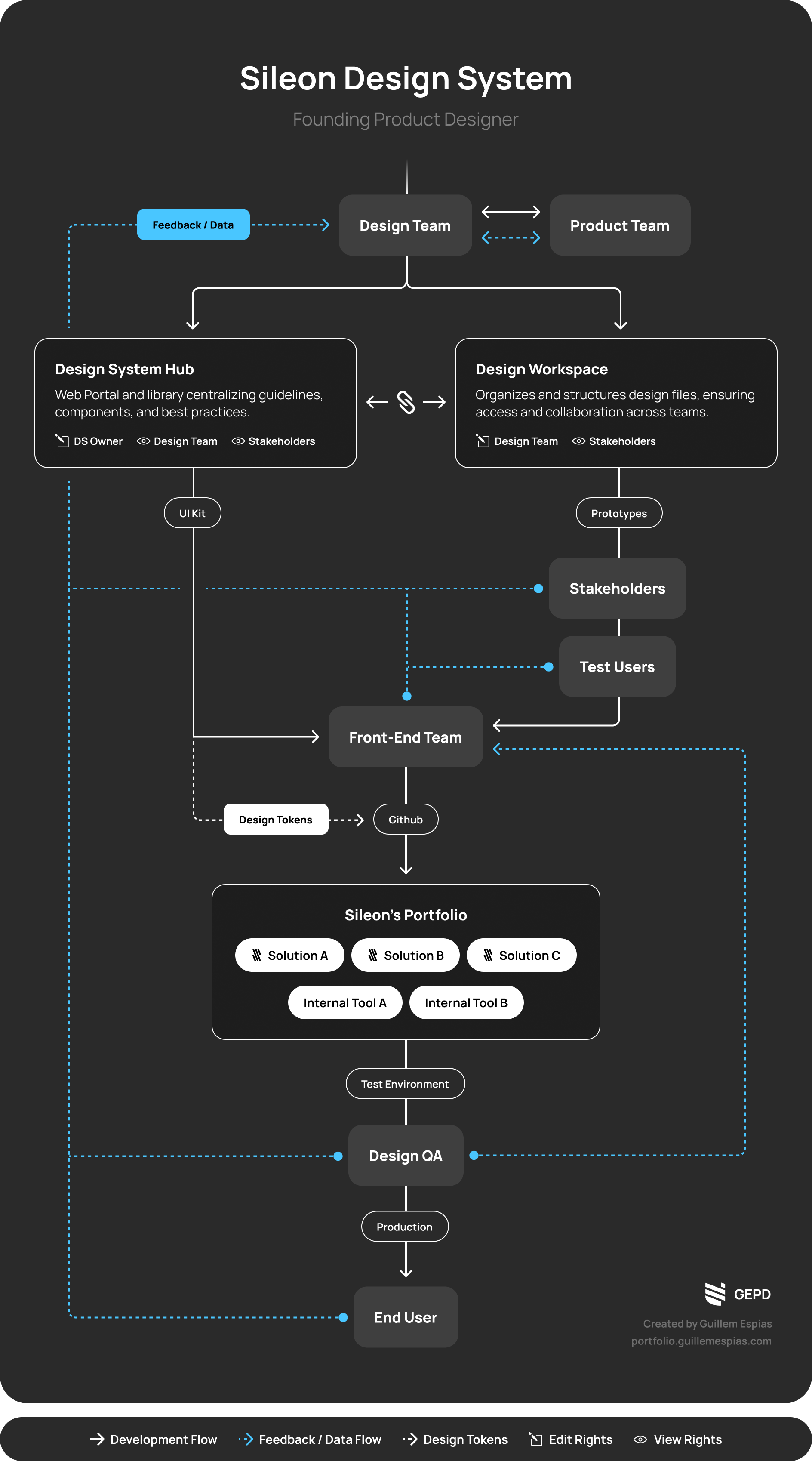
As with any product, having a dedicated team and resources for the design system is key, allowing continuous improvement, organic scalability, and keeping design debt to a minimum. I consistently advocated for this approach, encouraging involvement and co-ownership from the front-end team, and regularly communicating the system’s value and improvements during demo days.
Evolving with Figma
Such improvements included adopting design tokens and variables, which enabled light and dark theme integration as well as dynamic prototyping, and integrating our design system with GitHub—allowing pull requests to be submitted directly from Figma, streamlining the handover process.
Overall, the design system became a cornerstone of our efforts to build user-centric products, foster a strong design culture across teams, and ensure a consistent experience throughout the entire Sileon portfolio. It provided a robust, validated framework that enabled rapid high-fidelity prototyping and accelerated iteration cycles.
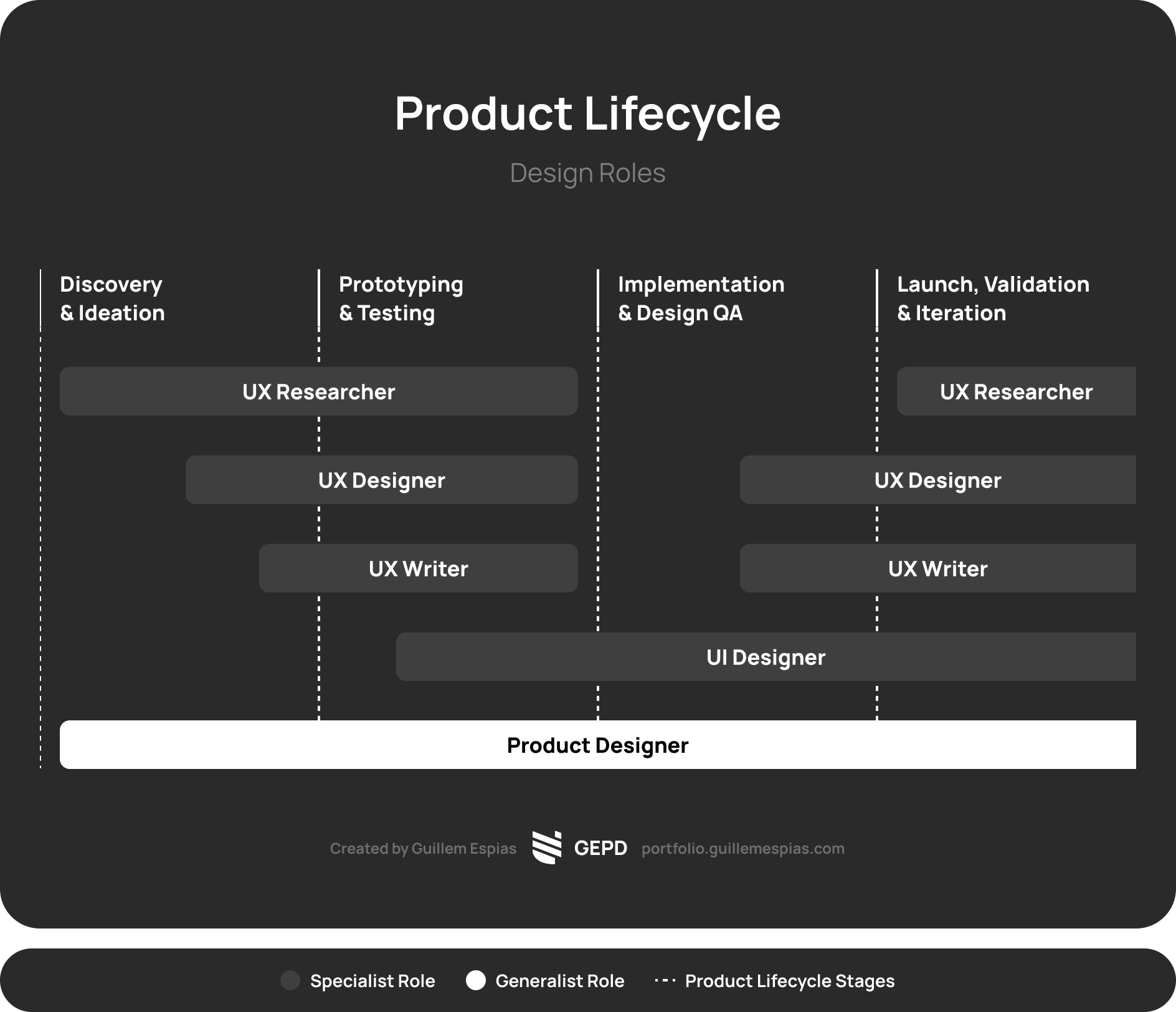
Note: This infographic was created for a demo day presentation at Sileon to help stakeholders better understand the different design roles and their areas of expertise. Specialist roles are often combined (e.g., UX/UI Designer, UX Designer & Researcher), and the Product Designer role—while typically a generalist—can also specialize in one or more areas depending on the team, context, and experience.
The Design Team
As the workload and my responsibilities grew, so did the need to expand the team. In close collaboration with the CPO, we began identifying key needs and defining role requirements. I took the lead throughout the hiring process—regularly syncing with the recruitment team, selecting candidates, conducting interviews, and assessing fit.
As new team members joined, I took ownership of their onboarding—introducing them to our product portfolio and design systems. In addition to that, I provided ongoing mentoring when needed, evaluated their progress, and gradually delegated responsibilities to support their growth within the team.
5. Wrap Up & Handover
Leaving Sileon
To ensure a smooth transition, I prepared a comprehensive handover guide, documenting key processes, contextual information, design resources, repositories, the status of ongoing work, and recommended next steps. The material was clearly structured to support continuity and enable the incoming design lead to assume responsibilities with clarity and minimal disruption.
As the last remaining member of the original product team, I left with a sense of completion—setting the sails for a new, in-between chapter as a solo indie game developer. But that’s a story for another time.
“I can highly recommend Guillem for any Product design position. He is creative, delivery focused and very skilled and experienced product designer. He is customer-centric and always consider how to add value for the user. Furthermore, he takes on challenges with his solution-oriented mindset, which always lead to great result. On top of that, he is an excellent team member and appreciated colleague.”
Bahareh Zand, CPO at Sileon
More Case Studies
Location-Based Navigation Design
This case study examines the design process of a navigation system tailored for a hybrid experience, where digital interfaces intersect with real-world exploration.